When it comes to towing your travel trailer or fifth wheel, few components are more important than your braking system. Whether you’re traveling through mountain passes, navigating busy highways, or heading out on your next camping adventure, properly functioning trailer brakes are essential for safe towing.
Many towable RVs come equipped with electric drum brakes, including self-adjusting models. However, more RV owners are considering upgrading to hydraulic disc brakes for improved braking performance, smoother operation, and additional confidence when towing.
At California RV Specialists, we’ve been helping RV owners with repairs, maintenance, and upgrades since 2003. One question we frequently discuss with customers is:
Should I keep my existing self-adjusting electric drum brakes or upgrade to hydraulic disc brakes?
Both systems have advantages, but understanding how they work, their maintenance requirements, and their differences can help you make an informed decision.
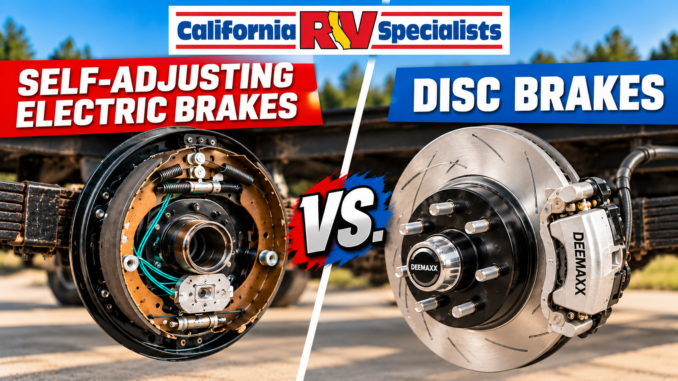
Understanding Self-Adjusting Electric Drum Brakes
Self-adjusting electric drum brakes are commonly found on travel trailers and fifth wheels.
Unlike conventional manually adjusted electric drum brakes, self-adjusting brakes incorporate a mechanism designed to maintain proper brake shoe clearance as the friction material wears.
How Do Self-Adjusting Electric Brakes Work?
When you apply the brakes in your tow vehicle, the trailer brake controller sends an electrical signal to the trailer’s brake magnets.
The magnets engage the rotating brake drums, activating a lever mechanism that presses the brake shoes against the inside of each drum.
The resulting friction slows the trailer.
Self-adjusting models incorporate a mechanical adjuster that progressively compensates for normal brake shoe wear during qualifying brake applications.
Important: Self-adjusting does not mean maintenance-free. These systems still require regular inspections, proper initial adjustment, and periodic servicing.
Advantages of Self-Adjusting Electric Drum Brakes
- Lower initial cost: Electric drum brakes are generally less expensive than hydraulic disc brake systems.
- Widely available parts: Replacement brake assemblies, magnets, shoes, and drums are commonly available.
- Familiar technology: Many RV service facilities have experience maintaining electric drum brakes.
- Automatic wear compensation: The adjustment mechanism helps maintain brake shoe clearance under normal operating conditions.
- Straightforward replacement: In many cases, complete backing plate assemblies can be replaced rather than rebuilding individual components.
For RV owners who travel occasionally, tow within appropriate weight limits, and maintain their equipment properly, electric drum brakes can provide reliable stopping performance.
What Are the Disadvantages of Self-Adjusting Electric Drum Brakes?
Although self-adjusting drum brakes are widely used, there are several limitations RV owners should understand.
1. Heat Buildup
Drum brakes retain more heat within the braking assembly than an exposed disc brake design.
During repeated braking, especially when descending steep grades, excessive heat can reduce braking effectiveness.
This condition is commonly called brake fade.
2. More Internal Components
Electric drum brakes contain brake shoes, springs, magnets, adjusters, and other mechanical components.
These parts can wear, corrode, break, or become contaminated.
3. Brake Adjustment Problems
Self-adjusting mechanisms can malfunction or become stuck due to corrosion, contamination, wear, or damaged components.
Improper shoe clearance can contribute to poor braking performance.
4. More Involved Inspections
A complete internal brake inspection requires removing the drums to evaluate the condition of the brake shoes, magnets, hardware, and braking surfaces.
5. Braking Performance Can Vary
Drum brake performance may change with heat, wear, adjustment, contamination, and operating conditions.
This is why routine maintenance is important, even on newer RVs.
Understanding Hydraulic Disc Brakes for Towable RVs
Hydraulic disc brakes are becoming an increasingly popular upgrade for fifth wheels, travel trailers, and other heavy towable trailers.
Unlike electric drum brakes, disc brakes use hydraulic pressure to activate brake calipers that squeeze brake pads against rotating metal rotors.
On most electric-over-hydraulic RV trailer conversions, an electrically controlled hydraulic actuator generates the pressure needed to operate the brakes.
How Do RV Disc Brakes Work?
When the driver applies the brakes, a compatible brake controller communicates with the electric-over-hydraulic actuator.
The actuator develops hydraulic pressure, which travels through brake lines to the calipers.
The calipers squeeze the brake pads against the rotors, slowing the trailer.
The system must be properly matched to the trailer, axle ratings, towing vehicle, and brake controller.
Advantages of Hydraulic Disc Brakes
1. Strong, Consistent Braking Performance
Properly designed and installed hydraulic disc brake systems can deliver excellent stopping performance and consistent brake response.
Many RV owners notice improved braking feel after upgrading from electric drum brakes.
Actual stopping distances depend on trailer weight, tire traction, brake controller operation, road conditions, and other factors.
2. Improved Heat Dissipation
Disc brakes generally dissipate heat more effectively than drum brakes.
This can help maintain more consistent braking performance during repeated stops or extended downhill travel.
3. No Brake Shoe Adjustment
Disc brake calipers automatically compensate for normal brake pad wear.
There is no drum brake shoe clearance adjustment to maintain.
4. Easier Visual Brake Inspections
Depending on the caliper and wheel design, technicians may be able to inspect portions of the brake pads and rotors without removing the entire braking assembly.
5. Simplified Friction Component Design
Disc brakes use pads, rotors, and calipers rather than the internal shoe, spring, magnet, and adjustment components found in electric drum brakes.
However, hydraulic systems introduce other service requirements, including fluid, hoses, lines, and actuators.
6. An Attractive Upgrade for Heavy RVs
Owners of larger travel trailers and fifth wheels, particularly those traveling frequently or towing through mountainous areas, may benefit from considering a properly engineered disc brake conversion.
Disadvantages of Hydraulic Disc Brakes
Disc brakes are not automatically the best choice for every RV owner.
Higher Installation Costs
A complete conversion generally costs more than servicing or replacing existing electric drum brakes.
Depending on the trailer, installation may require:
- Disc brake rotors and calipers
- Compatible hubs or hub-and-rotor assemblies
- Electric-over-hydraulic actuator
- Hydraulic brake lines and fittings
- Compatible brake controller or required interface equipment
- Brake fluid, bleeding, testing, and installation labor
Hydraulic System Maintenance
Disc brake systems require periodic inspection of hydraulic lines, fittings, calipers, fluid condition, and actuator operation.
Leaks, contaminated fluid, corrosion, or actuator problems can affect braking performance.
Compatibility Requirements
Not every disc brake kit fits every axle.
Axle capacity, spindle specifications, wheel bolt pattern, wheel clearance, tire and wheel ratings, and manufacturer requirements must all be considered.
More Specialized Components
Some hydraulic brake components may not be as readily available during roadside repairs as conventional electric drum brake parts.
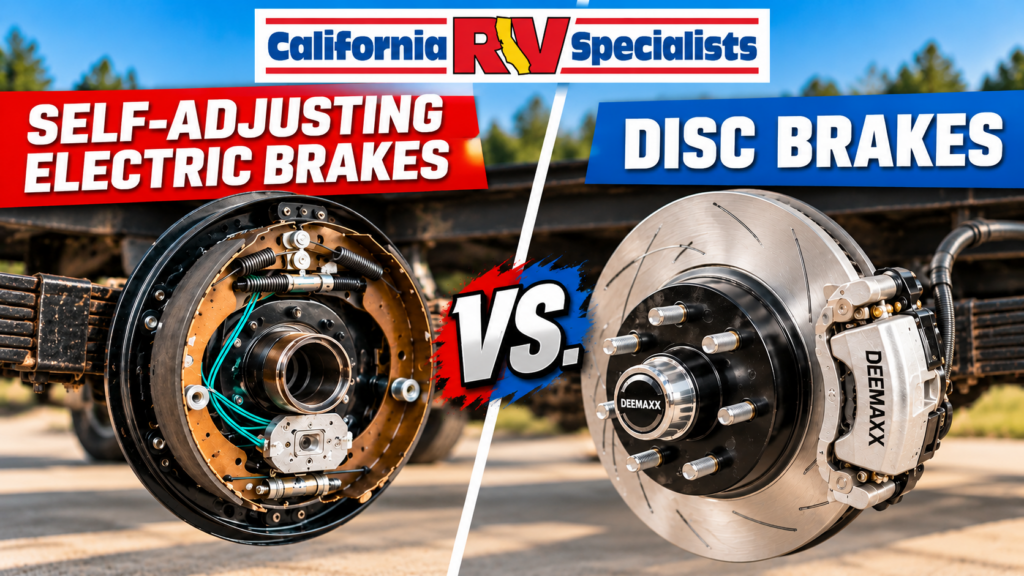
Self-Adjusting Electric Drum Brakes vs. Hydraulic Disc Brakes
| Feature | Self-Adjusting Electric Drum Brakes | Hydraulic Disc Brakes |
|---|---|---|
| Braking operation | Electric magnets activate brake shoes | Hydraulic calipers squeeze brake pads |
| Initial cost | Generally lower | Generally higher |
| Heat dissipation | More heat retained in drum | Generally better cooling |
| Brake adjustment | Self-adjusting shoe mechanism | No shoe adjustment |
| Friction material | Brake shoes | Brake pads |
| Routine maintenance | Shoes, magnets, drums, adjusters, hardware | Pads, rotors, calipers, hydraulic system |
| Brake fluid | Not required | Required |
| Brake controller | Compatible electric trailer controller | Compatible electric-over-hydraulic controller |
| Upgrade complexity | Often simpler replacement | More extensive conversion |
| Best suited for | Owners seeking economical, properly maintained braking | Owners prioritizing disc brake performance and willing to invest in an upgrade |
Both systems can provide safe and effective braking when correctly specified, installed, maintained, and operated.
Are Self-Adjusting Electric Drum Brakes Maintenance-Free?
Absolutely not.
One misconception we encounter is that self-adjusting brakes never need attention.
Even though the brake shoes are designed to compensate for wear, the system still contains components that can fail.
During a proper inspection, a technician may evaluate:
- Brake shoe thickness and condition
- Brake drum wear and surface condition
- Brake magnet wear
- Return springs and mounting hardware
- Self-adjusting mechanisms
- Brake wiring and electrical connections
- Brake controller operation
- Wheel bearings, seals, and related components
A self-adjusting mechanism cannot compensate for broken hardware, contaminated brake shoes, defective magnets, or damaged drums.
Self-adjusting does not mean self-maintaining.
Do Hydraulic Disc Brakes Still Require Maintenance?
Yes.
While disc brakes eliminate several components associated with drum brake systems, they still require regular inspections.
Typical maintenance considerations include:
- Brake pad wear
- Rotor condition and thickness
- Caliper operation
- Hydraulic brake hoses and lines
- Fluid condition and specified replacement intervals
- Hydraulic actuator operation
- Brake system leaks
- Electrical connections and controller compatibility
- Wheel bearings and seals
Maintenance intervals should follow the applicable component manufacturers’ recommendations and the RV’s operating conditions.
When Should You Consider Upgrading Your RV to Disc Brakes?
A disc brake upgrade may be worth discussing if:
- You own a larger or heavier fifth wheel or travel trailer.
- You frequently tow through mountain passes.
- You travel long distances throughout the year.
- You want improved braking consistency.
- Your existing drum brakes need extensive replacement.
- You are already planning axle, bearing, or suspension upgrades.
- You want to invest in a different braking system for long-term RV ownership.
A disc brake conversion should always be evaluated for compatibility and overall towing safety.
Upgrading trailer brakes does not increase the manufacturer’s GVWR, GAWR, or your tow vehicle’s rated towing capacity.
Can You Upgrade Your Existing Electric Drum Brakes to Disc Brakes?
Many towable RVs equipped with electric drum brakes can be converted to hydraulic disc brakes.
However, every trailer must be evaluated individually.
At California RV Specialists, we can inspect your existing setup and review important details such as axle ratings, hub specifications, wheel clearance, brake controller compatibility, and available conversion components.
We work with established trailer brake and suspension product manufacturers, including DeeMaxx, and can help determine which options are appropriate for your RV.
Not every trailer requires a complete disc brake conversion. Sometimes servicing or replacing existing electric drum brakes is the more practical and economical solution.
California RV Specialists: Brake Maintenance, Repairs, and Upgrades
Whether your travel trailer or fifth wheel has self-adjusting electric drum brakes or hydraulic disc brakes, California RV Specialists is here to help.
We’ve been helping RV owners maintain, repair, and upgrade their equipment since 2003.
Our Towable RV Brake Services Include
Electric Drum Brake Services
- Electric drum brake inspections
- Brake shoe and drum inspections
- Self-adjusting brake troubleshooting
- Brake magnet testing
- Brake assembly replacement
- Brake wiring and electrical troubleshooting
- Brake adjustment and maintenance
Hydraulic Disc Brake Services
- Disc brake inspections
- Disc brake conversion consultations
- Electric-to-hydraulic disc brake upgrades
- Brake pad and rotor inspections
- Hydraulic caliper and brake line service
- Electric-over-hydraulic actuator installation and troubleshooting
- Hydraulic brake bleeding and system testing
Related Trailer Maintenance and Upgrades
- Wheel bearing inspection and repacking
- Hub and seal replacement
- Axle and suspension inspections
- Leaf spring and shackle replacement
- Suspension upgrades
- Roadmaster Comfort Ride installations
- MORryde suspension upgrades
Our goal is to help you understand your RV’s current braking system and make informed decisions about maintenance, repairs, and upgrades.
Frequently Asked Questions
1. Are self-adjusting electric trailer brakes better than manually adjusted brakes?
Self-adjusting brakes help maintain proper shoe clearance as the brakes wear. They can reduce the need for periodic manual adjustment, but still require inspections and maintenance.
2. Are RV disc brakes better than electric drum brakes?
Disc brakes generally provide better heat dissipation and can offer more consistent braking performance. However, cost, maintenance, compatibility, and towing conditions should all be considered.
3. Do self-adjusting RV brakes need to be inspected?
Yes. Brake shoes, magnets, drums, springs, adjusters, and electrical components should be inspected according to the manufacturer’s service recommendations.
4. How often should RV trailer brakes be inspected?
Follow your axle and brake manufacturers’ maintenance schedules. Many trailer manufacturers recommend inspection at least annually or at specified mileage intervals, with additional checks for heavy use.
5. Can I convert my fifth wheel to hydraulic disc brakes?
Many fifth wheels can be converted, provided compatible components are available and the system is properly engineered and installed.
6. Do disc brakes require a different brake controller?
Electric-over-hydraulic systems require a compatible brake controller. Some existing controllers support these systems, while others require replacement or additional equipment.
7. Do disc brakes eliminate wheel bearing maintenance?
No. Wheel bearings, seals, and hubs still require maintenance regardless of whether the trailer uses drum or disc brakes.
8. Are disc brakes worth the cost?
For some RV owners, particularly those who frequently tow heavy trailers or travel through mountainous terrain, the additional investment may be worthwhile.
9. Can California RV Specialists repair my existing electric drum brakes?
Yes. We offer inspections, maintenance, troubleshooting, and brake repairs for towable RVs.
10. Does California RV Specialists install hydraulic disc brake upgrades?
Yes. We can evaluate your trailer and discuss available disc brake conversion options, including appropriate components and installation requirements.
Schedule Your RV Brake Inspection or Upgrade
Your RV’s braking system is not something you want to overlook.
Whether you’re experiencing poor braking performance, planning routine maintenance, replacing worn components, or considering a complete hydraulic disc brake upgrade, our experienced technicians can help.
California RV Specialists, LLC
200 S. Cherokee Lane
Lodi, CA 95240
Phone: (209) 263-7040
Email: service@calrvspecialists.com
Website: https://www.calrvspecialists.com
Family-owned and operated, serving RV owners since 2003.
We repair the RV you own — we don’t sell you a new one.