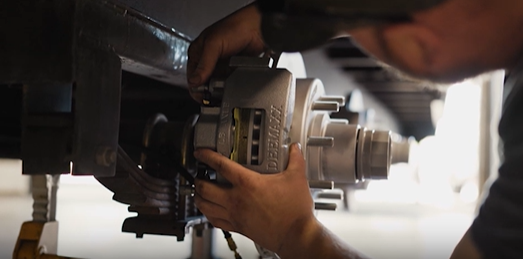
And Why More RV Repair Shops Are Installing Systems Like DeeMaxx
By Dustin Simpson
California RV Specialists | RVtravel.com Contributor
Over the last several years, one of the biggest trends I’ve seen in the towable RV industry is the growing number of RV owners upgrading from traditional electric drum brakes to hydraulic disc brake systems.
Honestly, I’m not surprised.
As RVs continue getting larger, heavier, and more feature-packed, many owners are discovering that factory-installed drum brakes often leave a lot to be desired — especially when towing through mountains, heavy traffic, wet conditions, or emergency braking situations.
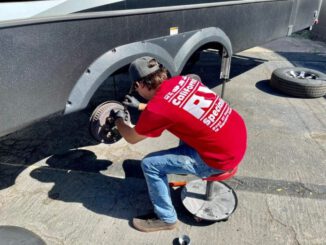
At California RV Specialists in Lodi, California, we routinely inspect suspension and braking systems on travel trailers, toy haulers, and fifth wheels. More and more customers are specifically asking us about hydraulic disc brake conversions after experiencing inconsistent braking, brake fade, excessive maintenance, or simply wanting better control and peace of mind while towing.
One of the more common systems we’ve been installing lately are DeeMaxx Disc Brake Kits.

Why RV Owners Are Losing Confidence in Drum Brakes
To be fair, electric drum brakes have been the standard in the RV industry for many years. They are relatively inexpensive and functional for basic towing needs.
But as trailer weights continue increasing, many RV owners are discovering the limitations of drum brakes pretty quickly.
Common complaints we hear include:
- Long stopping distances
- Inconsistent braking performance
- Brake fade during downhill grades
- Frequent brake adjustments
- Uneven braking
- Weak braking in wet conditions
- Excessive brake maintenance
- Overheating concerns on heavy RVs
Many owners don’t realize how hard RV braking systems work until they experience a close call, steep mountain descent, panic stop, or emergency maneuver.
That’s usually when the conversation about disc brakes begins.
Why Disc Brakes Are Becoming So Popular
Hydraulic disc brake systems offer several major advantages over traditional electric drum brakes.
The biggest thing most owners notice immediately is stopping confidence.
Disc brakes generally provide:
- Stronger braking performance
- More consistent brake application
- Better heat dissipation
- Improved wet-weather braking
- Reduced brake fade
- Easier maintenance
- Smoother braking feel
- Faster brake response
For heavier fifth wheels and toy haulers especially, the difference can be dramatic.
Heat Is the Enemy of Drum Brakes
One of the biggest weaknesses of drum brakes is heat buildup.
During long downhill grades or repeated braking situations, drum brakes can retain heat inside the enclosed drum assembly. As temperatures rise, braking performance often decreases — commonly referred to as brake fade.
Disc brakes dissipate heat much more efficiently.
Many systems, including DeeMaxx Disc Brake Kits, utilize vented rotors designed to cool quickly and maintain more consistent braking performance under load.
That can make a huge difference when towing in mountainous terrain or heavy stop-and-go traffic.
Better Performance in Wet Conditions
Another major advantage is wet-weather braking.
Traditional drum brakes are enclosed, which can allow water and debris to remain trapped longer inside the brake assembly. Disc brakes clear water much faster due to their open rotor and caliper design.
This often results in more predictable braking during rain or wet road conditions.
Reduced Maintenance Is a Big Selling Point
Another reason RV owners are switching is maintenance reduction.
Traditional drum brakes require periodic inspection, cleaning, adjustment, and servicing. Many owners either forget or don’t realize these adjustments are necessary.
Disc brake systems are generally self-adjusting and easier to service.
Brake pad inspections are simpler, and replacing pads is usually far easier than servicing enclosed drum assemblies.
That doesn’t mean hydraulic disc brakes are maintenance-free. Owners still need:
- Brake fluid inspections
- Occasional brake bleeding
- Bearing service
- Caliper slide lubrication
- Brake pad inspections
But overall, many RV owners appreciate the simpler maintenance process.
Corrosion Resistance Matters More Than People Think
One feature that has really caught the attention of RV owners is corrosion resistance.
Many RVs spend time:
- Near coastal environments
- In winter road salt conditions
- In storage for long periods
- Exposed to moisture and humidity
DeeMaxx systems utilize what they call “Maxx Coating,” which is designed for exceptional corrosion resistance. According to the manufacturer, the coating has been tested for over 1,000 hours in salt spray testing.
That’s become especially attractive for RV owners traveling throughout varying climates and road conditions.
Why More RV Shops Are Installing Disc Brake Systems
As customer demand increases, more RV repair facilities are investing time learning hydraulic disc brake installation and setup procedures.
Proper installation is critical.
A complete conversion typically includes:
- Hydraulic brake actuator installation
- Brake controller compatibility verification
- Hydraulic line routing
- Brake bleeding
- Bearing servicing
- Rotor and caliper installation
- Hub inspection
- Suspension inspection
- Brake system testing
At our shop, we often recommend inspecting the entire running gear system during a disc brake conversion, including:
- Suspension components
- Equalizers
- Wet bolts
- Shackles
- Springs
- Axle alignment
- Tires
- Bearings
Many RV owners upgrading brakes are also upgrading suspension systems at the same time.
DeeMaxx Disc Brake Kits Are Becoming More Common
One reason systems like DeeMaxx are gaining popularity is because they’re designed specifically for heavy-duty trailer and RV applications.
Common features include:
- Vented rotors
- Heavy-duty calipers
- Ceramic brake pads
- Corrosion-resistant coatings
- Self-adjusting calipers
- Slip-on rotor designs for easier serviceability
They are available for multiple axle capacities including:
- 3,500 lb axles
- 5,200 lb axles
- 6,000 lb axles
- 7,000 lb axles
That covers a large portion of today’s towable RV market.
Is a Disc Brake Conversion Worth It?
For many RV owners, the answer is yes.
Especially if you:
- Tow long distances
- Travel through mountains
- Tow a heavier fifth wheel or toy hauler
- Frequently encounter traffic
- Want improved braking confidence
- Plan on keeping the RV long term
In my opinion, braking systems are one of the most overlooked safety systems on towable RVs.
Most owners focus heavily on suspension upgrades, solar systems, lithium batteries, and accessories — but the ability to stop safely is just as important.
Final Thoughts
As RV weights continue increasing and owners travel farther than ever before, it’s easy to understand why hydraulic disc brake conversions are becoming more common throughout the RV industry.
While electric drum brakes still serve a purpose, many RV owners are discovering that hydraulic disc brakes offer improved safety, reduced maintenance, better braking performance, and greater towing confidence.
And honestly, once many owners tow with disc brakes, they usually don’t want to go back.
Dustin Simpson is the owner of California RV Specialists in Lodi, California, specializing in towable RV suspension, frame, brake, and running gear repairs and upgrades.
California RV Specialists
200 S. Cherokee Lane
Lodi, CA 95240
209-263-7040
www.calrvspecialists.com