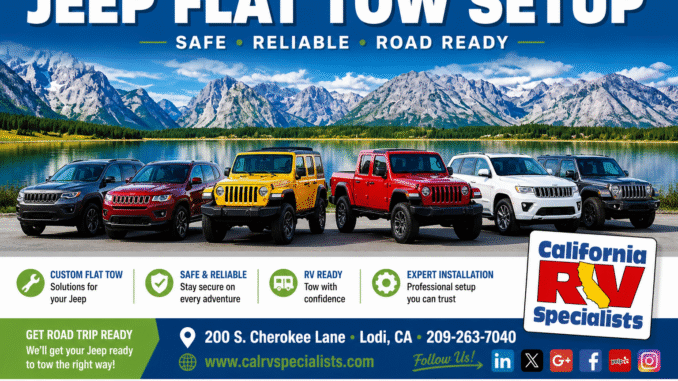
If you’re shopping for a Jeep, truck, SUV or car specifically to tow behind your motorhome, don’t wait until after you buy it to figure out whether it can be flat towed.
We’ve seen how easily this can become an expensive mistake.
A vehicle may look perfect for traveling behind your motorhome, and you may have even seen the same model being flat towed at a campground. But differences in model year, transmission, drivetrain, engine or vehicle configuration can change whether a particular vehicle is approved for recreational towing with all four wheels on the ground.
At California RV Specialists in Lodi, California, we install complete flat tow systems using equipment from Roadmaster, Demco and Blue Ox.
Our biggest advice before purchasing a vehicle specifically for flat towing is simple:

Verify that your exact vehicle is manufacturer-approved for four-down towing before you sign the paperwork.
Don’t Assume a Vehicle Can Be Flat Towed
Seeing another vehicle being towed behind a motorhome does not prove that your vehicle can be flat towed.
Even within the same model, one configuration may be approved while another isn’t.
Differences can include:
Model Year • Transmission • Two-Wheel Drive • Four-Wheel Drive • All-Wheel Drive • Transfer Case • Engine • Hybrid/EV Configuration • Other Drivetrain Components
Never base the decision solely on what someone tells you at a dealership, what you read in an online forum or what you’ve seen another RV owner towing.
Check the owner’s manual for the exact vehicle you’re considering and verify the manufacturer’s current requirements.
1. Check the Owner’s Manual Before Buying
Before purchasing the vehicle, locate the section of the owner’s manual covering terms such as:
Recreational Towing • Dinghy Towing • Four-Wheel-Down Towing • Towing Behind a Motorhome
You want to confirm that the exact vehicle configuration you’re considering is approved for towing with all four wheels on the ground.
If the manufacturer’s instructions say the vehicle isn’t approved for four-down towing, installing a base plate and tow bar doesn’t change that.
The towing equipment does not determine whether the vehicle can be flat towed—the vehicle manufacturer does.
2. Read the Entire Flat Tow Procedure
Finding a sentence saying the vehicle can be recreationally towed isn’t the end of your research.
Read the entire procedure.
Depending on the vehicle, the manufacturer may specify:
- Transmission position
- Transfer-case position
- Ignition settings
- Steering requirements
- Battery procedures
- Maximum towing speed
- Distance limitations
- Engine-starting intervals
- Fuse procedures
- Other preparation steps
You need to be comfortable performing those procedures every time you connect and disconnect the vehicle.
A vehicle that is technically flat-towable may not necessarily be the most convenient choice for how you travel.
3. Check the Vehicle’s Weight
Next, determine how much vehicle your motorhome can actually tow.
Don’t look only at a vehicle’s advertised starting weight.
Depending on the calculation you’re making, you may need to consider the vehicle’s actual or loaded weight, including equipment and anything carried inside it.
That can include:
Aftermarket Accessories • Tools • Cargo • Added Equipment • Flat Tow Components • Personal Items
Your towing setup needs to remain within all applicable motorhome, chassis, hitch and equipment ratings.
4. Know Your Motorhome’s Towing Capacity
Before buying a tow vehicle, determine the towing limitations of your motorhome.
Depending on the motorhome, relevant ratings and limitations can come from the motorhome manufacturer, chassis manufacturer and installed towing equipment.
Don’t assume that because your motorhome is large, it can tow any passenger vehicle behind it.
A larger truck or SUV may be considerably heavier than the vehicle you’re replacing.
5. Check the Receiver Hitch Rating
Look at the receiver hitch installed on the motorhome.
The hitch has its own rating, and that rating may not necessarily be the same as another towing-related rating associated with the motorhome.
This is important:
Installing a higher-capacity tow bar does not increase your motorhome’s towing capacity or receiver hitch rating.
The entire towing combination has to work within its applicable limits.
6. Transmission & Drivetrain Matter
This is one of the biggest reasons you should never shop based only on a vehicle’s model name.
A particular model with one drivetrain may be approved for recreational towing while another version may have completely different requirements or restrictions.
For example, there may be differences between:
Automatic vs. Manual Transmission
2WD vs. 4WD
4WD vs. AWD
Different Transfer Cases
Gas vs. Hybrid or Electric Configurations
Never assume that because one version can be flat towed, every version can.
Verify the exact vehicle you’re purchasing.
7. Check for Battery Requirements
Modern vehicles contain increasingly sophisticated electronics.
Depending on the vehicle and flat tow setup, battery management may need to be considered.
Some applications may use a charge line or other manufacturer/system-specific solution to help maintain the tow vehicle battery during travel.
But battery requirements vary by vehicle.
Don’t automatically disconnect a battery, pull a fuse or install a charge line because another RV owner does it.
Follow the vehicle manufacturer’s instructions and the requirements of the installed towing equipment.
8. Is a Base Plate Available?
Even after you’ve confirmed the vehicle can be flat towed, there’s another important question:
Is an appropriate base plate available for your exact vehicle?
Base plates are generally vehicle-specific.
At California RV Specialists, we work with manufacturers including:
Roadmaster • Demco • Blue Ox
Before you buy the vehicle, it can be worthwhile to confirm that the necessary towing components are available for the exact year, make, model and configuration you’re considering.
This can be especially important with newly released or recently redesigned vehicles.
9. What Supplemental Braking System Will You Use?
A complete flat tow setup involves more than connecting a tow bar.
Depending on the application and applicable requirements, you’ll also need to determine the appropriate supplemental braking system for the towed vehicle.
There are different styles of braking systems, and each has its own installation and operating characteristics.
Your setup may also include:
Breakaway Equipment • Motorhome Connections • Tow Vehicle Connections • Monitoring/Indicator Components • Additional Wiring
We recommend considering the braking system before purchasing the tow vehicle, not after everything else has already been installed.
10. How Will the Tow Vehicle Lights Work?
Your tow vehicle needs an appropriate lighting solution while being towed.
The exact wiring setup depends on the vehicle and equipment being installed.
Modern vehicles can have complex electrical systems, so this isn’t always as simple as connecting a few wires to the taillights.
The vehicle may require a specific wiring kit, modules or other components.
Again, this is something worth researching before buying the vehicle.
11. Consider the Complete Cost of Setting Up the Vehicle
Don’t budget only for the tow bar.
A complete flat tow installation can involve:
Tow Bar • Vehicle-Specific Base Plate • Supplemental Braking System • Safety Cables • Breakaway Equipment • Lighting/Wiring • Electrical Components • Charge Line Where Appropriate • Receiver Adapter Where Appropriate • Installation Labor
The final setup depends on the particular motorhome and vehicle combination.
If you’re comparing two possible vehicles to purchase, it can be useful to determine what equipment is available for each one and what the complete installation may involve.
12. Used Vehicle? Look for Existing Flat Tow Equipment
Sometimes you’ll find a used vehicle that already has a base plate or other towing components installed.
That can appear to be a bonus—but don’t automatically assume the equipment is ready to use.
Have it inspected.
You may not know:
Who installed it • How old it is • How many miles it has been towed • Whether it was maintained • Whether it’s damaged • Whether all required components are present • Whether it’s compatible with your motorhome equipment
Existing equipment should be identified and evaluated before you depend on it.
13. Don’t Mix and Match Equipment Without Checking Compatibility
It’s common for RV owners to already own a tow bar and then purchase another tow vehicle.
Before assuming the old tow bar will work with the new base plate, verify compatibility.
Adapters may be available for certain applications, but the fact that two components can physically be connected doesn’t necessarily mean the manufacturers approve that combination.
Check compatibility, ratings and installation requirements first.
14. Think About How Easy the Vehicle Will Be to Use
There’s another consideration that isn’t purely technical:
How convenient will this vehicle be to tow?
If you travel frequently, you’ll be connecting and disconnecting the vehicle regularly.
Think about:
- Manufacturer-required preparation
- Hookup procedure
- Disconnect procedure
- Tow bar operation
- Braking-system setup
- Battery requirements
- Vehicle weight
- Ground clearance
- Storage of removable components
- What you’ll use the vehicle for once you reach your destination
The best tow vehicle for one RV owner may not be the best choice for another.
Before You Buy, Do Your Homework
If you’re standing on a vehicle lot considering a car specifically because you want to tow it behind your motorhome, don’t let the excitement of buying the vehicle cause you to skip the research.
Before signing, confirm:
Is the exact vehicle manufacturer-approved for flat towing?
What procedures must be followed?
What does the vehicle weigh?
Can my motorhome tow that weight?
What is my receiver hitch rated for?
Is a base plate available?
What braking system will be required?
What wiring will be required?
Are there battery-management considerations?
What will the complete flat tow setup involve?
Those questions are much easier to answer before you own the vehicle.
Call California RV Specialists Before You Buy
If you’re considering purchasing a vehicle specifically for flat towing, you’re welcome to contact California RV Specialists before making the purchase.
Once you’ve confirmed through the vehicle manufacturer that the exact vehicle is approved for four-down recreational towing, we can help research the availability of compatible base plates, tow bars, supplemental braking systems, wiring and other flat tow equipment.
Sometimes spending a little time researching the setup before purchasing the vehicle can prevent a very expensive surprise afterward.
Choose the vehicle. Verify it can be flat towed. Verify your motorhome can tow it. Then build the correct towing system around it.
California RV Specialists LLC
Flat Tow Installation • Tow Bars • Base Plates • Braking Systems • Wiring • Parts & Service
200 S. Cherokee Lane
Lodi, CA 95240
209-263-7040
service@calrvspecialists.com
CaliforniaRVSpecialists.com
Serving the RV community since 2003.
Roadmaster • Demco • Blue Ox
Experts You Can Count On.