Quality Parts, Proper Installation, and Preventative Maintenance Make a Difference
When it comes to your travel trailer or fifth wheel, the braking system is one of the most important safety components on your RV.
At California RV Specialists, we’ve been servicing, repairing, and upgrading RV braking systems since 2003. Over the years, we’ve worked with different types of electric drum brakes, including manually adjusted and self-adjusting brake assemblies.
When replacing electric drum brake assemblies and a self-adjusting system is appropriate for the application, one of our preferred choices is the Lippert Forward Self-Adjusting Electric Brake Assembly.
Why do we choose Lippert?
Because we want to install quality replacement components that are properly matched to the RV, provide dependable braking performance, and help maintain the correct brake shoe adjustment during normal use.
However, even the best brake assembly still requires regular inspection and maintenance.
What Are Lippert Forward Self-Adjusting Electric Brakes?
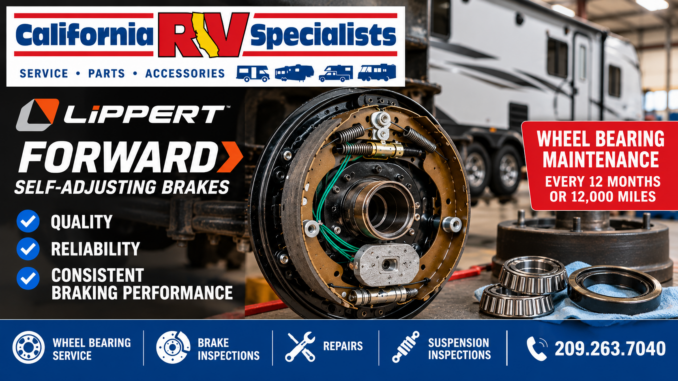
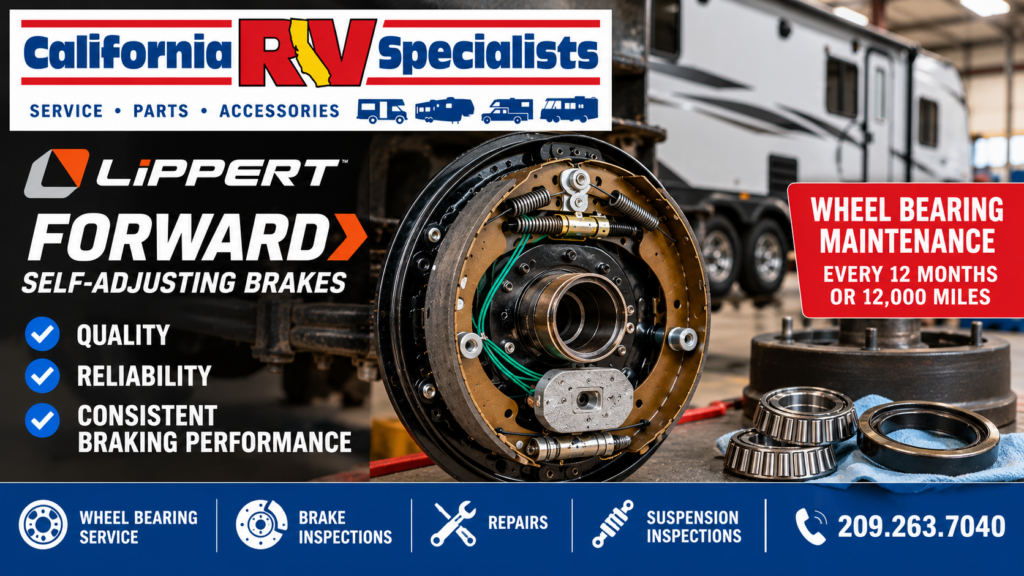
Lippert Forward Self-Adjusting Electric Brakes are designed to automatically compensate for normal brake shoe wear during forward braking applications.
Traditional electric drum brakes require periodic manual adjustment to maintain the proper clearance between the brake shoes and drums.
If the brake shoes become excessively loose, braking performance can suffer.
Lippert’s forward self-adjusting design incorporates a mechanical adjustment system that helps maintain proper brake shoe-to-drum clearance as the brakes are used.
This can provide more consistent brake engagement throughout the service life of the brake shoes.
The important difference is that the brakes are designed to maintain their adjustment automatically rather than relying entirely on periodic manual adjustment.
Initial setup, break-in, inspections, and maintenance are still necessary.
Why California RV Specialists Prefers Lippert Forward Self-Adjusting Brakes
1. Automatic Brake Shoe Adjustment
One of the biggest advantages is the forward self-adjusting mechanism.
During normal forward braking, the system is designed to compensate for brake shoe wear and help maintain proper clearance.
This reduces the likelihood of excessive shoe-to-drum clearance developing between maintenance services.
For RV owners who travel frequently, maintaining proper brake adjustment is an important part of consistent braking performance.
2. More Consistent Braking Performance
Brake shoe adjustment plays an important role in how electric drum brakes operate.
When brake shoes are excessively loose, the system may not respond as effectively as it should.
Lippert’s forward self-adjusting design helps maintain the correct clearance as the brake linings wear.
This can contribute to more consistent brake operation when the system is properly installed, adjusted, broken in, and maintained.
Lippert advertises improved stopping performance compared with standard electric brakes under its stated comparison conditions.
Actual stopping performance will depend on the RV’s weight, tires, road conditions, brake controller settings, and overall braking system condition.
3. Quality Replacement Brake Assemblies
Another reason we choose Lippert is the availability of complete replacement brake assemblies.
These assemblies are designed to incorporate the brake shoes, magnets, springs, adjusters, backing plates, and related components.
When an existing brake assembly has excessive wear or damaged components, replacing the complete assembly may be more practical than repairing several individual parts.
It also provides an opportunity to replace multiple worn braking components together.
4. Proper Fitment for Different RV Axles
Lippert offers forward self-adjusting brake assemblies in different sizes, mounting configurations, and axle applications.
Common configurations include brake assemblies for 3,500-pound and 4,000- to 7,000-pound axle applications, with additional options for certain heavier axles.
However, brake assemblies must be selected according to the actual axle and brake specifications.
At California RV Specialists, we evaluate the existing brake system before recommending replacement components.
We consider brake dimensions, axle ratings, mounting configurations, left- and right-hand assemblies, and component compatibility.
Just because a brake assembly looks similar does not mean it is the correct replacement for your RV.
5. Reduced Need for Manual Brake Adjustment
Self-adjusting electric brakes can reduce the need for routine manual shoe adjustment after the initial setup.
This is especially beneficial for RV owners who put substantial mileage on their travel trailers or fifth wheels.
However, self-adjusting brakes are not maintenance-free.
The adjustment mechanism can still become damaged, corroded, contaminated, or worn.
Brake shoes, magnets, drums, wiring, and other components must still be inspected.
6. A Manufacturer with Extensive RV Industry Experience
Lippert is a major supplier of RV chassis, axle, suspension, and braking components.
Their product range and availability of replacement parts are additional reasons we consider their forward self-adjusting brake assemblies when recommending repairs.
Our preference is based on choosing a suitable product for the application—not suggesting that every competing brake assembly is inferior.
Are Lippert Forward Self-Adjusting Brakes Better Than Other Brands?
There are several manufacturers of electric drum brake assemblies, and many offer quality products.
We believe that choosing a brake assembly should involve more than comparing prices.
Proper fitment, component design, parts availability, installation, and ongoing maintenance are all important considerations.
For applicable electric drum brake replacements, Lippert Forward Self-Adjusting Brake Assemblies are among the products we prefer to recommend.
That doesn’t mean every trailer needs new brakes or that a Lippert assembly is automatically the right choice for every axle.
Our goal is to evaluate the braking system and recommend an appropriate repair.
Self-Adjusting Does Not Mean Maintenance-Free
One of the biggest misconceptions among RV owners is that self-adjusting electric brakes never need to be inspected.
That is simply not true.
Self-adjusting brakes can still experience:
- Worn brake shoes and magnets
- Damaged brake drums
- Broken or weakened springs
- Stuck or damaged adjustment mechanisms
- Grease contamination from failed seals
- Electrical wiring problems
- Corroded connections
- Uneven brake operation
A self-adjusting mechanism cannot correct a failed magnet, grease-contaminated brake lining, or damaged brake drum.
This is one reason we strongly encourage RV owners to keep up with their regular wheel bearing and brake maintenance.
Wheel Bearing and Brake Maintenance: Every 12 Months or 12,000 Miles
At California RV Specialists, our standard recommendation for traditional serviceable trailer wheel bearings and brakes is:
Every 12 months or every 12,000 miles, whichever comes first.
Always follow the axle and component manufacturer’s maintenance requirements if they specify a different or more frequent service interval.
Some specialized sealed or cartridge-style wheel-end systems have different maintenance procedures.
Why is this service so important?
Because your wheel bearings, hubs, brakes, tires, and suspension work together every time you tow.
During routine maintenance, our technicians have an opportunity to inspect components that RV owners may never see during normal operation.
Problems discovered during these inspections may help prevent costly repairs, brake failures, bearing damage, or roadside breakdowns.
What Does Our Wheel Bearing, Brake, and Suspension Service Include?
At California RV Specialists, our published wheel bearing pack service includes much more than simply adding grease.
1. Wheel Bearing Inspection
We inspect serviceable wheel bearings for signs of wear or damage.
This includes evaluating the condition of accessible bearings and related components during disassembly.
2. Cleaning and Repacking Wheel Bearings
We clean and repack serviceable wheel bearings using appropriate bearing grease and procedures.
Proper bearing lubrication is important for reducing friction, heat, and premature wear.
3. Replacing Grease Seals
We replace grease seals as part of our standard traditional wheel bearing pack service.
Failed seals can allow grease to escape and potentially contaminate the brake components.
4. Brake Inspection
We inspect the brake assemblies for wear, damage, and visible problems.
Depending on the brake system, this includes checking brake shoes, drums, magnets, adjustment mechanisms, and associated hardware.
5. Brake Cleaning, Adjustment, and Testing
Our service includes cleaning and adjusting electric drum brake shoes as required, along with testing brake operation.
Even self-adjusting brakes require proper initial setup and verification.
6. Tire Pressure Inspection and Adjustment
We check and adjust tire pressures to the appropriate specifications for the application.
Correct tire inflation is important for tire performance, load carrying, and towing safety.
7. Wheel Lug Nut Torque
We torque the wheels to the applicable specifications.
Proper wheel installation and torque are critical after wheel removal.
8. Shackle Link Inspection
We inspect suspension shackle links for visible wear or damage.
Worn shackles and related hardware can contribute to suspension movement and component failures.
9. Leaf Spring Inspection
We inspect leaf springs for visible cracking, damage, or other concerns.
10. Spring Hanger Inspection
We inspect suspension hangers and their mounting areas for visible damage, cracking, or movement.
11. Suspension Weld Inspection
We visually inspect accessible welds associated with the axle and suspension mounting components.
Cracked or damaged welds should be addressed before continued towing.
12. Axle Wiring Inspection
We inspect accessible wiring at the axles for visible damage or concerns.
Damaged brake wiring can affect the operation of electric trailer brakes.
Important: These inspections are part of our published standard service scope. Additional diagnostics, component replacements, structural repairs, and suspension upgrades may require separate authorization and charges.
Why We Inspect Suspension Components During Wheel Bearing Service
Your trailer’s braking system does not operate independently of the suspension.
Every time you accelerate, brake, turn, or travel over uneven roads, the suspension and axle assemblies experience changing forces.
Worn bushings, damaged shackles, cracked hangers, broken springs, and loose or damaged mounting components can create serious towing concerns.
That’s why we believe wheel bearing service is an excellent opportunity to look at the surrounding running gear.
We don’t want to focus only on the bearings while overlooking an obvious suspension problem.
What If Your RV Needs New Brake Assemblies?
If our technicians discover worn or damaged electric brake assemblies, we’ll discuss the condition of the components and available repair options.
Depending on the application, we may recommend replacing worn brake assemblies with appropriately matched Lippert Forward Self-Adjusting Electric Brakes.
We can also evaluate brake drums, hubs, wiring, and related components.
If you’re interested in upgrading beyond electric drum brakes, we can discuss hydraulic disc brake conversion options as well.
Electric Drum Brakes or Hydraulic Disc Brakes? We Can Help With Either.
Not every RV owner needs to upgrade to disc brakes.
Properly maintained electric drum brakes can provide reliable braking performance when correctly specified for the trailer.
However, some owners may prefer the braking characteristics and heat dissipation of a hydraulic disc brake system.
At California RV Specialists, we provide:
- Electric drum brake inspections and maintenance
- Lippert forward self-adjusting brake assembly replacement
- Brake magnet and wiring troubleshooting
- Brake drum and hub replacement
- Wheel bearing service and grease seal replacement
- Hydraulic disc brake inspections and repairs
- Electric-over-hydraulic disc brake upgrades
- Suspension inspections, repairs, and upgrades
Our goal is to help you select the right service or upgrade for your RV.
Frequently Asked Questions
Do Lippert forward self-adjusting brakes need manual adjustment?
They require proper initial adjustment and setup. Afterward, the forward self-adjusting mechanism is designed to maintain brake shoe clearance during normal operation. Inspections are still necessary.
Are Lippert forward self-adjusting brakes compatible with Dexter axles?
Certain Lippert brake assemblies are compatible with applicable Dexter axle and brake configurations. Exact brake dimensions, mounting patterns, axle ratings, and manufacturer specifications must be verified.
How often should I service my RV wheel bearings?
Our general recommendation for traditional serviceable wheel bearings is every 12 months or 12,000 miles, whichever comes first, unless the component manufacturer specifies otherwise.
Can you inspect my brakes during wheel bearing service?
Yes. Brake inspection, cleaning, adjustment as required, and operational testing are included in our published standard wheel bearing and brake service.
Can you replace my existing brakes with Lippert self-adjusting assemblies?
Yes, when the appropriate compatible assemblies are available for your trailer.
Do you inspect the suspension during wheel bearing maintenance?
Yes. Our standard service includes visual inspection of shackle links, springs, hangers, accessible welds, and axle wiring.
Does California RV Specialists install hydraulic disc brakes?
Yes. We can evaluate your travel trailer or fifth wheel for a compatible hydraulic disc brake conversion.
Schedule Your Wheel Bearing, Brake, and Suspension Service
When was the last time your travel trailer or fifth wheel had its wheel bearings serviced and brakes inspected?
If it’s been more than 12 months or 12,000 miles, it may be time to schedule maintenance.
Whether you need routine wheel bearing service, brake inspections, Lippert Forward Self-Adjusting Brake Assemblies, suspension repairs, or a hydraulic disc brake upgrade, we’re here to help.
California RV Specialists, LLC
200 S. Cherokee Lane
Lodi, CA 95240
Phone: (209) 263-7040
Email: service@calrvspecialists.com
Website: www.calrvspecialists.com
Independent RV Service, Repairs, Maintenance & Upgrades Since 2003.
We repair the RV you own — we don’t sell you a new one.