
When was the last time you checked the hydraulic leveling system on your motorhome or fifth wheel?
Hydraulic leveling systems make setting up your RV much easier, but like any mechanical system, they require periodic inspection and maintenance.
At California RV Specialists in Lodi, California, we regularly inspect and repair RV hydraulic leveling jacks, pumps, hoses, reservoirs, and related components.
We’ve seen hydraulic hoses deteriorate, fittings develop leaks, jacks stop operating, and fluid levels drop because of problems that went unnoticed.
A little preventive maintenance can help identify developing issues before they leave you unable to level your RV, retract your jacks, or operate a hydraulic slide-out room.
How Does an RV Hydraulic Leveling System Work?
Many motorhomes and fifth wheels use hydraulic leveling systems to raise, lower, and stabilize the RV when parked.
These systems generally use a combination of:
- An electric motor and hydraulic pump.
- A hydraulic fluid reservoir.
- Hydraulic hoses and fittings.
- Control valves or manifolds.
- Hydraulic leveling cylinders or jacks.
- Electronic controls and sensors.
When activated, the pump moves hydraulic fluid through the system to extend or retract the appropriate components.
Some RVs also use the same hydraulic power unit to operate slide-out rooms.
Because these systems rely on hydraulic pressure, electrical controls, and mechanical components working together, a failure in one area can affect the entire system.
Why RV Hydraulic Leveling Maintenance Is Important
Your leveling system may sit unused for weeks or months, especially if your RV remains in storage or stays parked at a campsite for extended periods.
During that time, hydraulic components can experience deterioration, corrosion, contamination, or other problems.
Regular maintenance helps identify:
- Low hydraulic fluid levels.
- Leaking hoses or fittings.
- Damaged hydraulic lines.
- Deteriorated seals.
- Corrosion on exposed jack components.
- Unusual pump operation.
- Loose electrical connections.
- Damaged jack feet or mounting hardware.
- Irregular leveling jack or slide-out movement.
A small hydraulic leak may not seem serious initially, but continued fluid loss can eventually prevent the system from operating correctly.
1. Check Your RV Hydraulic Fluid Level
One of the most important maintenance checks involves the hydraulic fluid reservoir.
However, there’s an important detail many RV owners overlook.
The proper fluid level depends on the position of the leveling jacks and hydraulic slide-outs.
On many systems, the reservoir is checked with the leveling jacks fully retracted and hydraulic slide-outs in the manufacturer’s specified positions. Other systems have different requirements.
Always follow the instructions for your specific leveling system.
If the fluid level is low, don’t immediately assume the reservoir simply needs to be topped off.
Low fluid may indicate:
- A leaking hydraulic hose.
- A damaged fitting.
- A leaking jack cylinder.
- A reservoir or pump connection leak.
- Previous improper servicing.
Adding fluid without identifying the cause may temporarily restore operation while allowing the underlying problem to continue.
Never overfill the reservoir or mix hydraulic fluids without verifying compatibility. Use only the fluid type specified by the equipment manufacturer.

2. Inspect Hydraulic Hoses for Damage
Hydraulic hoses are exposed to road vibration, temperature changes, movement, and environmental conditions.
Over time, hoses can develop cracks, abrasion damage, leaks, or deterioration.
During inspections, look for:
- Visible cracking or deterioration.
- Wet areas around hose fittings.
- Abrasion against frame members.
- Kinked or pinched hoses.
- Loose or damaged mounting supports.
- Hoses routed near sharp edges or moving components.
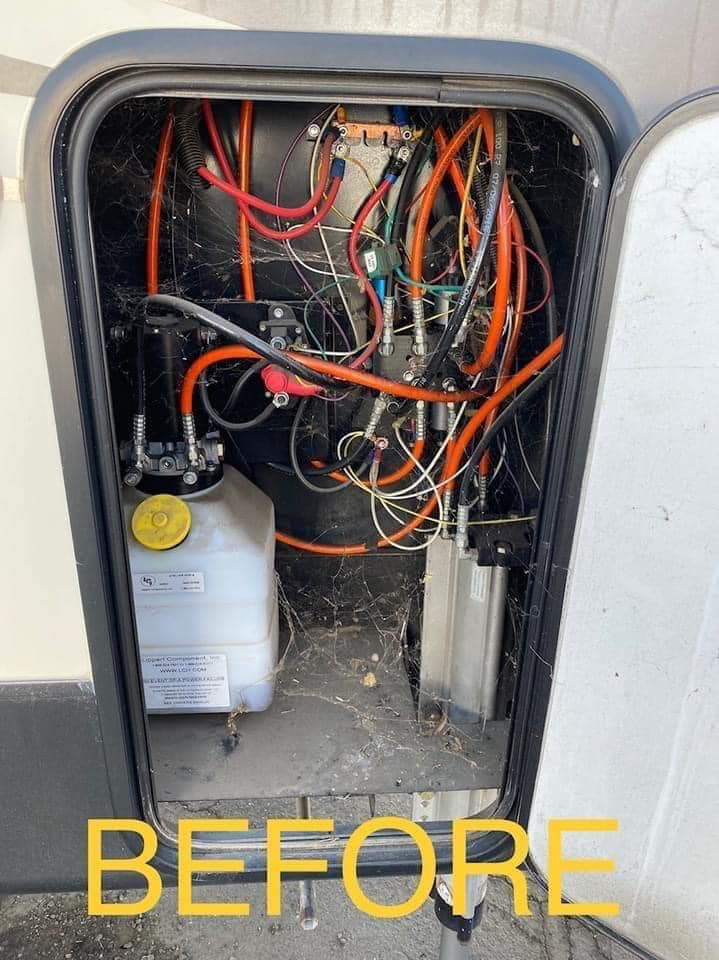
One of the original photographs accompanying this article shows hydraulic hose damage discovered during service.

A damaged hydraulic hose should be evaluated and replaced with a correctly rated, compatible component when necessary.
Never attempt to locate a pressurized hydraulic leak with your bare hands. High-pressure hydraulic fluid can penetrate the skin and cause a medical emergency.
3. Inspect Hydraulic Leveling Jacks
Hydraulic leveling jacks are exposed to dirt, moisture, road debris, and changing weather conditions.
During routine inspections, look for visible fluid leaks, corrosion, damaged jack feet, bent components, or irregular operation.
Also inspect accessible mounting hardware and surrounding attachment points for damage.
Some leveling jack manufacturers recommend specific cleaning or lubrication procedures, while others prohibit applying certain products to the exposed jack rods.
Do not automatically spray lubricant, silicone, or grease onto hydraulic jack rods.
Follow the maintenance instructions for your particular system.


4. Operate Your Hydraulic Leveling System Periodically
If your RV sits in storage for extended periods, periodic system operation may help reveal problems before your next trip.
For many owners, checking the system approximately once a month is a practical reminder, provided the manufacturer permits that schedule and the RV can be operated safely.
When testing the system:
- Park on suitable, stable ground.
- Follow the manufacturer’s parking brake and transmission requirements.
- Keep people and objects clear of moving components.
- Operate the system using the proper control sequence.
- Listen for unusual noises.
- Watch for uneven or incomplete jack movement.
- Verify that the jacks retract properly.
Never crawl beneath an RV supported only by hydraulic leveling jacks.

5. Don’t Forget Hydraulic Slide-Out Rooms
Some RV hydraulic systems operate both the leveling jacks and the slide-out rooms.
When these components share a pump, reservoir, or hydraulic controls, a problem in one part of the system may affect another.
Watch for slide-out rooms that move unevenly, operate slowly, stop unexpectedly, or fail to fully extend or retract.
Hydraulic slide-out systems may also have individual cylinders, hoses, valves, and mechanical components that require inspection.
Never force a slide-out room that is binding or operating abnormally.
Common Signs Your RV Hydraulic Leveling System Needs Repair
Contact an RV repair facility if you notice any of the following:
Leveling Jacks Won’t Extend or Retract
Possible causes include electrical faults, hydraulic problems, control system issues, or mechanical damage.
Hydraulic Pump Runs but Nothing Moves
This may involve low fluid, valve problems, pump issues, or other system faults.
One Leveling Jack Moves Slower Than the Others
Uneven movement can indicate a hydraulic restriction, mechanical problem, control issue, or another developing fault.
Hydraulic Fluid Appears Under the RV
Visible hydraulic fluid should be investigated before continued operation.
Leveling Jacks Drift or Lose Position
Unexpected movement may indicate an internal or external hydraulic problem or another system concern.
The Leveling System Displays an Error Code
Electronic leveling systems may store faults related to sensors, wiring, voltage, calibration, or system operation.
The correct diagnosis depends on the equipment manufacturer and model.
What Hydraulic Fluid Should You Use?
Not all RV hydraulic leveling systems use the same fluid.
Some manufacturers specify particular automatic transmission fluids, while others require different hydraulic fluids or approved formulations.
Using the wrong fluid can affect system operation and may damage seals or other components.
Before adding or replacing fluid, consult the leveling system’s service documentation.
Avoid assuming that all red-colored hydraulic fluids are interchangeable.
How Often Should an RV Hydraulic Leveling System Be Serviced?
We recommend inspecting your leveling system as part of your regular RV maintenance routine.
A practical approach is to perform visual checks before major trips and arrange a more detailed professional inspection at intervals appropriate for the equipment, its age, usage, and condition.
For many RV owners, an annual inspection is a reasonable starting point, but the manufacturer’s maintenance schedule should always take priority.
Full-time RV owners, frequent travelers, and owners who operate their systems regularly may benefit from more frequent checks.
Professional RV Hydraulic Leveling Repairs in Lodi, California
At California RV Specialists, we’ve been helping RV owners maintain, repair, and protect their recreational vehicles since 2003.
Our technicians work with a variety of hydraulic and electric leveling systems, including equipment from Lippert, HWH, Power Gear, Equalizer, Bigfoot, and other manufacturers.
Depending on the system and concern, our services may include:
- Hydraulic leveling system inspections.
- Hydraulic hose and fitting repairs.
- Hydraulic fluid leak diagnosis.
- Leveling jack troubleshooting.
- Pump, motor, and valve diagnostics.
- Electrical and control system troubleshooting.
- Leveling system maintenance and lubrication where applicable.
Whether your hydraulic leveling jacks are leaking, moving slowly, or failing to retract, our team can evaluate the concern and recommend the appropriate repair.
Don’t wait until your leveling jacks fail at a campground or refuse to retract when you’re ready to travel.
Contact California RV Specialists to schedule a hydraulic leveling system inspection or repair.
Contact California RV Specialists
California RV Specialists – Independent RV Service & Repair Facility
Address:
200 S. Cherokee Lane
Lodi, CA 95240
Phone: (209) 263-7040
Website: www.calrvspecialists.com
Business Hours:
Monday – Friday: 8:00 AM – 4:00 PM
Closed for Lunch: 12:00 PM – 1:00 PM
Saturday & Sunday: Closed
Serving RV Owners Since 2003
Proudly serving RV owners throughout Lodi, Stockton, Galt, Elk Grove, Sacramento, Modesto, and surrounding Northern California communities.
We Don’t Sell RVs – We Repair the RV You Own!