RV roof maintenance is one of the most important responsibilities of owning a recreational vehicle. Unfortunately, some well-intentioned repairs can create additional problems, especially when the wrong materials or techniques are used.
One product that frequently comes up in RV owner discussions is RV roof repair tape, sometimes referred to as roof patch tape, sealing tape, or Eternabond-style tape.
These products can be effective when used correctly and in approved applications. However, covering every roof seam, molding, and existing sealant with adhesive tape isn’t necessarily the best way to protect your RV.
At California RV Specialists in Lodi, California, we’ve been repairing and maintaining RVs since 2003. We’ve encountered numerous situations where previous roof repairs made future inspections and maintenance more complicated.
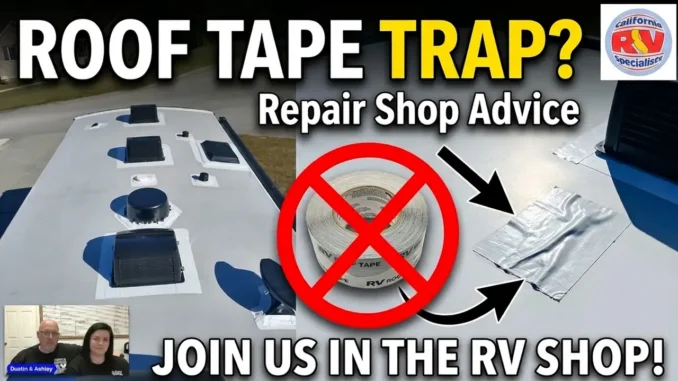
In our accompanying YouTube video, Dustin and Ashley sit down to discuss a post shared by an RV group member who applied roof repair tape over their existing roof sealants. We explain why this approach deserves careful consideration before other RV owners attempt the same thing.
Why Are RV Owners Applying Roof Tape Over Their Sealants?
Many RV owners purchase roof repair tape because it’s advertised as a convenient way to seal roof seams, repair damaged roofing materials, and prevent water intrusion.
The appeal is understandable. Rather than inspecting and maintaining individual roof joints, some owners decide to cover large areas with adhesive tape in hopes of creating a long-lasting waterproof barrier.
But here’s the concern: covering an existing sealant doesn’t automatically correct the condition underneath it.
If the original sealant has separated, the molding is loose, or the underlying surface is damaged, applying tape over the area may leave the original problem unresolved.
And depending on the installation, it can make future repairs more difficult.
Five Problems With Applying Roof Tape Over Existing RV Sealants
1. Roof Tape Can Hide Deteriorating Sealants
One of the biggest concerns is losing the ability to visually inspect the original sealant and the joint underneath.
RV roof sealants can shrink, crack, separate, and deteriorate due to UV exposure, temperature changes, and normal movement.
When those areas are completely covered with tape, it may become difficult to identify developing problems beneath the repair.
2. Adhesive Tape Can Make Future Repairs More Difficult
Many roof repair tapes use aggressive adhesives designed to bond tightly to compatible surfaces.
While that can be beneficial for certain repairs, removing the tape later may require considerable labor.
Depending on the roofing material, adhesive, and installation, removal can also risk damaging the membrane or surrounding materials.
What started as a simple preventive maintenance project may eventually become a much more expensive repair.
3. Improper Installation Can Create New Water Entry Points
Roof repair tape requires proper surface preparation and installation.
Dirt, moisture, incompatible sealants, uneven surfaces, wrinkles, or poor adhesion can interfere with the intended seal.
If an edge lifts or a channel forms, water may travel beneath the tape.
This is particularly concerning around roof moldings, transitions, and fastener locations.
4. Tape Doesn’t Repair Loose Moldings or Damaged Components
RV roof moldings and termination strips are often secured with mechanical fasteners and appropriate sealing materials.
If a molding is loose, fasteners are failing, or the joint underneath is compromised, placing tape over the outside does not necessarily correct those conditions.
The underlying assembly may need to be inspected and repaired before an exterior seal is applied.
5. Future Roof Maintenance May Become More Expensive
At California RV Specialists, we encourage RV owners to consider how today’s maintenance decisions will affect tomorrow’s repairs.
A roof covered with extensive adhesive tape may require additional preparation or removal work if the roof membrane, moldings, or underlying structure need service.
The cost and difficulty depend on the tape product, roofing system, installation quality, and condition of the materials.
Join Dustin and Ashley from California RV Specialists as they review an RV group member’s roof tape application and discuss the potential problems with covering existing RV roof sealants.
Is RV Roof Repair Tape Always a Bad Idea?
No. There are legitimate applications for roof repair tape.
Certain products are designed for specific roof repairs, compatible seams, or approved roofing systems.
When properly selected, installed, and maintained according to the product and roof manufacturer’s instructions, roof repair tape can be an effective repair material.
The concern isn’t simply that someone used tape.
The concern is using tape as a universal replacement for proper roof inspection, sealant maintenance, and necessary structural repairs.
Not every roofing membrane, sealant, or joint is compatible with every adhesive product.
Before installing roof tape, verify the manufacturer’s requirements, including surface preparation, approved substrates, application conditions, and any potential warranty implications.
What Do We Recommend Instead?
At California RV Specialists, our approach to roof maintenance begins with a thorough inspection.
We recommend:
- Inspecting roof seams, moldings, and sealants regularly.
- Identifying cracked, separated, loose, or deteriorated materials.
- Checking roof termination moldings and accessible fasteners for concerns.
- Cleaning and preparing surfaces using approved products.
- Using sealants compatible with the roofing system and specific application.
- Repairing loose or damaged components before resealing.
- Following the RV and roofing manufacturers’ maintenance requirements.
In many situations, properly maintained roof sealants provide a practical solution without covering large portions of the roof with adhesive tape.
However, the correct repair method depends on the roof construction and condition.
How Often Should You Inspect Your RV Roof?
Many RV manufacturers recommend frequent roof and exterior sealant inspections.
As a general preventive maintenance practice, we encourage RV owners to inspect roof seams and sealants approximately every three months, or according to their manufacturer’s specific schedule.
Additional inspections are important after severe storms, possible roof impacts, and extended storage.
Here in California, intense sunlight and temperature changes can contribute to premature deterioration of certain sealants and plastic components.
Remember, water damage doesn’t always produce visible stains or dripping water inside the RV.
By the time an interior leak becomes noticeable, hidden damage may already exist.
Free RV Roof Inspections at California RV Specialists
At California RV Specialists, we’ve been helping RV owners maintain and repair their recreational vehicles since 2003.
Our independent RV repair facility is located in Lodi, California, and we work with customers throughout Stockton, Sacramento, Modesto, Elk Grove, Galt, and surrounding Northern California communities.
We offer free RV roof and exterior body inspections to help identify potential maintenance concerns.
Our services include:
- RV roof inspections and maintenance
- RV roof resealing and sealant repairs
- RV roof repairs and roof renewal coatings
- Complete exterior body resealing
- RV slide-out inspections and repairs
- Wheel bearing and brake services
- Suspension upgrades and installations
- Manufacturer warranty repairs for participating brands
We are an independent RV repair facility and do not sell recreational vehicles.
Schedule Your Free RV Roof Inspection in Lodi, California
If you’ve applied roof repair tape to your RV or are considering covering existing roof sealants, we encourage you to have the roof evaluated before making major changes.
Our team can inspect the condition of the roofing materials and help determine whether the existing installation requires attention.
California RV Specialists
200 S. Cherokee Lane
Lodi, CA 95240
Business Hours: Monday–Friday, 8:00 AM–4:00 PM
Closed for lunch: 12:00 PM–1:00 PM
Website: https://www.calrvspecialists.com/
Free Inspections: RV roof and exterior body inspections, slide-out inspections, and fifth-wheel hitch inspections.
Please contact our office to schedule an appointment. We operate as a drop-off repair facility and do not offer mobile RV service.
The bottom line: RV roof repair tape can be useful when properly selected and installed, but covering every seam and existing sealant isn’t automatically better protection. Inspect the underlying conditions, use compatible materials, and make sure today’s maintenance doesn’t create more expensive problems tomorrow.